Author: sammi275joe

  • Perfectly Unfinished Me Devotions: Pondering the Promises

    Perfectly Unfinished Me Devotions: Pondering the Promises

    Have you ever had a promise spoken over your life that you expected would have happened by now?

    Well, having recently turned 50, I’ve found myself pondering a few things!

    There are all these general social norms of achievement expected by society, aren’t there? Marriage, children, grandchildren, a successful career, a thriving business. The list goes on.

    Grandchildren? What the heck? I was late getting married, let alone having grandchildren!

    And what else? I thought I’d have a successful business by now, at least by the world’s standards.

    But that’s the thing, isn’t it? By whose standards should we be measuring our lives?

    I seriously thought at 21 that 50 was ancient and that by now I’d be married, with children and grandchildren, or at the very least a fully fledged author living in a penthouse apartment in Manhattan, overlooking the beautiful city, in some kind of romantic Danielle Steel movie.

    Well, that clearly hasn’t happened, but we can dream!

    The years have taught me a few things, and one of them is how easily we compare ourselves with other people.

    We look at what someone else has achieved and suddenly feel like we’ve fallen behind. Or, if we’re doing a little better than someone else, we can become rather pleased with ourselves.

    Neither is particularly helpful, is it?

    But perhaps the question isn’t simply whether we’re comparing ourselves. Perhaps it’s what we’re measuring our lives against in the first place.

    Rather than looking at what everyone else has achieved, what if we started looking at what God has spoken? What He’s already done, what He’s promised and what we’re still waiting to see?

    What if, instead of measuring our lives against the world’s expectations, we began weighing up our circumstances in light of His Word?

    And that brings me to someone who knew a thing or two about having a promise spoken over her life.

    Mary.

    Mary and that little word ‘pondered’

    Luke 2:19 (NKJV) tells us:

    “But Mary kept all these things and pondered them in her heart.”

    Now, I wonder how many of us have read that verse and just carried on to the next one without giving it another thought.

    I know I could have!

    But that word pondered is rather interesting.

    In the original Greek, the word is symballousa, from symballō (Strong’s G4820). It carries the meaning of bringing things together in the mind, considering them and weighing them up.

    Matthew Henry, in his commentary on Luke 2:19, explains how Mary kept these things in her heart so she could consider them alongside what God would reveal later.

    So Mary wasn’t necessarily just remembering what she’d heard. She was holding these things in her heart, considering what had happened and what they might mean.

    And that got me thinking.

    What exactly was Mary pondering?

    Well, let’s go back to where it all started.

    Mary was visited by the angel Gabriel, who told her she would give birth to a son named Jesus. But this wasn’t going to be just any child!

    He would be called the Son of the Highest, He would be given the throne of David, and His kingdom would have no end (Luke 1:31–33).

    That’s quite a promise to receive, isn’t it?

    And Mary’s response?

    “Let it be to me according to your word.” — Luke 1:38 (NKJV)

    Then, after Jesus was born, along came the shepherds, telling Mary and Joseph what the angels had announced to them. A Saviour had been born, who was Christ the Lord (Luke 2:10–17).

    And that’s when we read that Mary kept all these things and pondered them in her heart.

    But it didn’t stop there.

    When Mary and Joseph took Jesus to the temple, Simeon recognised Him as God’s salvation. Yet he also told Mary that a sword would pierce her own soul (Luke 2:25–35).

    Now, I wonder how much of that she actually understood at the time.

    Years later, when Jesus was twelve, Mary and Joseph found Him in the temple after searching for Him. Jesus spoke about His Father’s business, but they didn’t understand what He meant.

    And once again, Scripture tells us that Mary kept these things in her heart (Luke 2:41–51).

    There she was again, holding on to those words.

    Is this the moment?

    Now think about this.

    Mary had been given these extraordinary words about her son. She knew who He was, yet she still had to watch Him grow up like any other child.

    I wonder how many times she looked at Him and thought, Is this it? Is this going to be the moment? Is this when He’s going to reveal who He is? Is this when He’s going to begin doing what was spoken about Him?

    Imagine watching Him grow, year after year, knowing what had been promised but not knowing when or how it would all unfold.

    And I wonder whether every new moment brought another question.

    Is this it? Is this the beginning? Is this what we’ve been waiting for?

    Because isn’t that what we do?

    We receive a promise, we believe it, and then we start looking for it.

    Something happens and we think, Oh, perhaps this is it!

    Then it doesn’t happen.

    So we wait a little longer.

    And then something else happens, and our expectations rise again.

    Surely this time?

    But still nothing.

    And sometimes, after years of waiting, we begin wondering whether we’ve misunderstood something, whether we’ve missed the moment, or whether it’s ever going to happen at all.

    Jesus was around thirty when He began His public ministry. Mary had carried those words in her heart for approximately thirty years.

    And then came the wedding at Cana.

    When the wine ran out, Mary turned to Jesus and told Him about the problem. And despite His response that His hour had not yet come, she turned to the servants and said:

    “Whatever He says to you, do it.” — John 2:5 (NKJV)

    Now that’s faith in action!

    She didn’t know exactly what He was going to do, but she knew who He was. She recognised the need, brought it to Him and instructed the servants to obey Him.

    But here’s another thing.

    Sometimes the fulfilment of a promise doesn’t look anything like we imagined.

    Mary had been told that her son would reign and that His kingdom would have no end. Yet she also stood near the cross and watched Him suffer.

    Can you imagine that?

    The very son she’d been promised, the one she’d carried, raised and loved, now hanging on a cross.

    And remember what Simeon had told her? That a sword would pierce her own soul.

    The fulfilment of God’s purposes wasn’t without pain.

    And sometimes, even when God is working something out, the journey can be painful as well as wonderful.

    What promise are you waiting for?

    So let me ask you something.

    What promise have you been given?

    Are you discouraged? Are you seriously wondering whether it’s ever going to happen? Have you reached the point where you’re thinking about giving up?

    Because let me encourage you.

    Things don’t always happen in our timing. And just because something hasn’t happened yet doesn’t automatically mean God has forgotten what He’s spoken.

    Look at Abraham.

    God promised him a son, but the years went by and still nothing. Eventually, Sarah suggested that Abraham have a child through Hagar, and Abraham agreed (Genesis 16).

    They tried to make something happen themselves.

    And don’t we sometimes do exactly that?

    We get tired of waiting and start trying to work everything out ourselves.

    But Isaac came in God’s appointed time.

    And then there were those in Hebrews 11 who died in faith without seeing the complete fulfilment of what God had promised.

    Not everyone’s journey looked the same.

    Now, I know what you’re thinking.

    Hang on a minute! Didn’t she just tell us not to compare ourselves with other people? And here she is, going on about everyone else’s journey in the Bible!

    Well, yes, I know!

    But have you noticed the difference?

    We’re not looking at their lives to make ourselves feel inadequate or to measure how far behind we think we are.

    We’re looking at what God did in their lives to encourage ourselves in ours!

    There’s a big difference between looking at someone else’s journey and thinking, Well, they’ve achieved all that and I haven’t. What’s wrong with me? and looking at it and thinking, Wow! Look what God did for them. If He was faithful to them, I can trust Him to be faithful to me too!

    Romans 15:4 reminds us that the things written before were written for our learning, so that through the Scriptures we might have patience, comfort and hope.

    Other people’s testimonies should encourage our faith, not become another measuring stick to beat ourselves with!

    I’ve had to learn this myself

    For years, I believed God had promised me that I would get married.

    Now, I know marriage isn’t a promise given to everyone. Paul speaks about singleness as a calling too (1 Corinthians 7).

    But on several occasions, I’d been encouraged that singleness wasn’t what God had for me, and that He was preparing the right person at the right time.

    People would often say to me, “You need to get yourself right before you get married.”

    But is that necessarily true?

    I sincerely believe that had I married at a much younger age, my insecurities could have ruined it. I was so afraid of rejection that I think I would have struggled enormously.

    And I believe God knew that.

    I’d struggled with alcohol misuse, with my self-worth and with believing I was good enough.

    But that doesn’t mean I had to have everything sorted out before getting married. Far from it!

    I needed to allow God to work on those insecurities to a point where I could enter a marriage and continue growing within it.

    Because let’s face it, getting married doesn’t suddenly make all your problems disappear!

    You don’t walk down the aisle, say “I do”, and suddenly become a completely different person.

    You’re still you, with all your quirks, insecurities and things that need working on. Only now, you’re learning to work through some of those things with someone else.

    And God continues working on both of you.

    But something else changed in my life.

    I stopped making marriage the thing I was chasing and started seeking God’s kingdom first. Funnily enough, I had actually become so free and so content with being single that I almost missed the fact that my best friend of six months was the very person God had put right in front of me. And I couldn’t have picked better

    People often would say to me, “It’ll happen to you when you stop looking for it.”

    I used to tell them that was a cop-out phrase married happy people said!

    Now I can’t say they were right in every instance, but they were certainly right in mine.

    It wasn’t as though I thought “Right let’s seek God’s Kingdom first instead, then I’ll get married.”

    I just got so fired up with what God had done in my life that I wasn’t even thinking of marriage.

    I’d reached a point where I could genuinely say to the Lord. “Ok well, this is awesome Jesus, You’re enough for me.”

    Matthew 6:33 tells us to seek first the kingdom of God and His righteousness.

    And in time, I did get married.

    Not because I’d suddenly become perfect, but because God had been working in my life, and that work continues today.

    I’ve also had to learn to stop believing things other people had spoken over me.

    I was told I wouldn’t make it academically.

    Yet I went on to get a degree!

    But it wasn’t until I stopped trying to achieve things to please my parents and started putting my trust in God, doing it for Him, that things began to change.

    And when I’ve struggled with feeling inadequate, I’ve looked at people like Gideon.

    Gideon saw himself as the least in his father’s house, from the weakest clan in Manasseh (Judges 6:15). Yet God called him a mighty man of valour!

    Then there’s Moses, who questioned his ability to speak and lead, yet God still called him.

    And Joseph!

    Well, Joseph was a bit of a pompous so-and-so when he was younger, wasn’t he? At least that’s how he can come across when you read about him telling everyone his dreams!

    But look at what he went through before those dreams began to come to pass.

    Betrayal, slavery, false accusations and imprisonment.

    His circumstances certainly didn’t look much like the promise!

    And that’s the point I’m making.

    We all have different personalities, different struggles and different journeys. I’m not saying everyone’s circumstances are the same, but quite often, when we’re struggling with something, we can find someone in Scripture who faced something similar.

    Not so we can compare ourselves and feel worse.

    But so we can see how God worked in their lives and be encouraged that He can work in ours too.

    Because the same God who was faithful to them is faithful today.

    And the funny thing is, when we think we’re ready, we’re often not. Yet when we feel completely unprepared, that’s often when God tells us to go!

    Look at Moses. He certainly didn’t think he was ready! He had every excuse under the sun, including his inability to speak well. Yet God still called him.

    We don’t have to be perfect or have everything figured out before we step out in faith. We just have to be willing to obey and allow God to continue working in us along the way.

    Because the journey doesn’t end when the promise comes to pass. In many ways, it’s only just beginning!

    But what if you’ve never received a promise?

    Perhaps you’re reading this and thinking, Well, that’s all very well, but I haven’t even been given a promise!

    And perhaps you’re wondering why.

    Why has someone else received a prophetic word and you haven’t? Is there something wrong with you? Has God forgotten about you?

    Absolutely not!

    Because here’s something we mustn’t forget.

    We have already been given the greatest promise of all through Jesus Christ.

    Those who came before Christ were looking forward to the promised Messiah. They were waiting for what God had spoken to be fulfilled.

    But we’re living on the other side of the cross!

    Jesus has come. He’s died. He’s risen again.

    Salvation has been made available to us through Him (Ephesians 2:8–9).

    Isaiah 53:5 speaks of healing through His wounds, and 1 Peter 2:24 declares that by His stripes we were healed.

    And Philippians 1:6 tells us that He who began a good work in us will complete it until the day of Jesus Christ.

    Isaiah 55:11 reminds us that God’s Word will not return to Him void, but will accomplish what He pleases and fulfil the purpose for which He sent it.

    So even if you’ve never received a personal prophetic word, you haven’t been left without God’s promises.

    They’re right there in His Word.

    And this is where we need to change what we’re looking at.

    Rather than constantly measuring our lives against what other people have achieved, what if we started weighing up our circumstances against what God has already spoken?

    What if, instead of focusing on everything that hasn’t happened, we started remembering everything that already has?

    Jesus Himself declared:

    “It is finished!” — John 19:30 (NKJV)

    And Hebrews 10:12 tells us that after offering one sacrifice for sins forever, He sat down at the right hand of God.

    He sat down!

    Not because He’d given up, but because His sacrificial work was complete.

    We aren’t waiting for Jesus to go back to the cross. He’s already accomplished what was necessary for our salvation.

    And now we have His Word to stand on.

    That doesn’t mean every personal expectation will happen exactly as we imagine, or that everything will happen immediately. But it does mean we can trust what God has truly promised.

    And we have a part to play in that.

    We can believe His Word, speak it, act on it and allow it to renew our minds.

    Remember what He’s already done

    David encouraged himself in the Lord when everything seemed to be falling apart (1 Samuel 30:6).

    And we can do that too.

    We can go back to God’s Word. We can remind ourselves of what He’s already done, what He’s promised through Jesus Christ and how He’s been faithful to us over the years.

    Because sometimes we become so focused on what hasn’t happened that we forget everything that already has.

    And perhaps that’s why remembering is so important.

    Think about the Israelites and the Passover.

    God instructed them to remember how He had delivered them from Egypt. The blood on the doorposts, their deliverance and the freedom He brought them into weren’t things they were supposed to forget.

    They were to remember and tell future generations what God had done.

    And shouldn’t we be doing the same?

    Looking back, not to dwell on our disappointments or measure ourselves against the past, but to remember God’s faithfulness.

    To remind ourselves that the same God who was faithful then is faithful now.

    And there’s one more question I think we need to ask ourselves.

    When we’re believing for a promise, whose glory are we actually seeking?

    Is it about what we want to achieve, what we want people to see, or how successful we want our lives to look?

    Or is it ultimately about glorifying our Saviour?

    Because surely that’s what matters most.

    One little word

    And to think, all of this came from one little verse about Mary pondering things in her heart!

    How many times do we read something in the Bible and just skim over it, thinking there’s not much to it?

    I know I’ve done it!

    Yet here we are, looking at one word, pondered, and discovering just how much there is to think about.

    And perhaps that’s something else we can learn from Mary.

    Sometimes we need to stop, take time with God’s Word and really consider what He’s saying, rather than rushing on to the next verse.

    Because you never know what you might discover when you take the time to ponder.

    And perhaps, while you’re waiting for the next promise to be fulfilled, God has something to show you in the words He’s already spoken.

    We musn’t become so focused on what hasn’t happened that we forget what God has already done.

  • This Week’s Nonsense: Two weeks off. I’d like a refund.

    I booked two weeks off work.

    I had plans.

    Rest. Writing. Quiet time with the Lord. Getting a few things done. Perhaps even returning to work refreshed.

    It was going to be glorious.

    Instead, I appear to have spent two weeks doing everything except resting.

    I’d like a refund.

    The trouble with free time is that it doesn’t remain free for very long. It’s more like an unattended parking space. Leave it empty for approximately thirty seconds and something else gets in it.

    One of the things we’d planned to do was cancelled. After we had travelled there and made our temporary abode, only 36 hours later a serious incident meant the event was cancelled and we had to leave. Obviously the circumstances were far more important than our holiday plans, but it did leave us unexpectedly trying to work out what on earth to do with the rest of the week.

    Then there were chickens to rehome, building materials arriving, an outside room to sort out, a husband with a bad back, a dog who continues to regard walking nicely on a lead as an unreasonable infringement of his civil liberties, and, naturally, I decided this would also be an excellent time to start embellishing jackets.

    Because apparently what I needed during my restful fortnight was another project.

    The Chickens Were Served Notice

    After approximately two years of chicken ownership, I have reached a conclusion.

    I wish we’d never got chickens or rather, I wish we’d got fewer chickens. But if you’re a chicken keeper, you will know about what they call chicken maths. You go to get two and come back with six, then twelve then go back for more. There’s just one problem. Chicken maths equals manure maths.

    There. I’ve said it.

    Gareth wanted chickens. I wasn’t particularly bothered about having them, although when we first got them I did enjoy them. They were ridiculously cute when they were little, they had funny little personalities, and when I had more time, watching their antics could actually be quite calming.

    Then life got busier.

    Work. Writing a book. The blog. Trying to manage three businesses. General life.

    And chickens, I discovered, do not become less demanding simply because you have become more busy.

    Before the Facebook Poultry Tribunal convenes, the chickens have gone to a lovely home with a garden where they can spend far more time outside, which is exactly what I wanted for them.

    Because I’ve learned never to read the comments on a Facebook chicken group.

    Someone can innocently post:

    “Does anyone know how I can stop my chicken knocking over its water?”

    Seventeen minutes later, strangers are questioning their suitability to own animals, their moral character, their childhood and possibly the state of their marriage.

    And the poor person is sitting there thinking:

    I just wanted a heavier water bowl.

    Surely it’s better to admit that your life has changed and responsibly rehome them somewhere with more room to poo than keep them purely because you’re frightened of offending Facebook.

    And believe me, they need the room.

    Because chickens apart from being fun are quite possibly the most disgusting creatures I have ever encountered.

    Six or seven chickens don’t poo.

    They stage a manure massacre. Hence manure maths.

    Gareth has spent approximately two years attempting to solve the chicken-water problem.

    They poo in the water.

    New water solution.

    They poo on top of the water solution.

    New water solution.

    They knock it over.

    Another water solution.

    They find an entirely new and previously unforeseen method of contaminating it.

    At no point have the chickens acknowledged Gareth’s considerable contribution to poultry sanitation.

    Then there’s the cost.

    People talk about keeping chickens as though you’re going to wander into the garden every morning, collect your lovely free eggs and congratulate yourself on your self-sufficient lifestyle.

    Free?

    By the time you’ve bought the chickens, the house, the fox-proofing, bedding, food, grit, feeders, drinkers and seventeen generations of increasingly sophisticated water-containment technology, one of them eventually produces an egg worth about 30p.

    Thank you.

    Excellent return on investment.

    So yes, the chickens have gone.

    And I have never been so relieved to see chickens leave.

    Zeb’s Forbidden Delicatessen

    There was, however, one member of the household who was considerably less pleased by their departure.

    Zeb.

    Because while the rest of us saw chickens, Zeb apparently saw catering.

    I have watched this dog turn his nose up at a perfectly decent bowl of food as though I’ve personally insulted him.

    But chicken droppings?

    Apparently we’re dining at The Ritz.

    He would actually follow the chickens around waiting for a fresh delivery.

    There are things you expect when you get a dog.

    Walks. Mud. Hair. Vet bills.

    You do not expect to find yourself standing in the garden shouting:

    “ZEB! NO!”

    at a dog who is apparently treating a chicken as a mobile snack dispenser.

    Once you’ve witnessed that, there are some things you simply cannot unsee.

    0a8c0c04-9163-461a-b425-94758068d0ca

    The Peaceful Sanctuary That Doesn’t Exist Yet

    The former chicken area is now being turned into an outside room.

    Eventually.

    Gareth sees an office.

    I see somewhere I can disappear to where nobody can find me.

    Same building. Entirely different aspirations.

    Unfortunately, we’re still probably another couple of weeks away from it being finished, so I have successfully removed the chickens but have not yet received the solitude.

    And naturally, building an outside room involves materials.

    Materials need delivering.

    Materials need moving.

    Materials, I have discovered, have apparently been designed for people with hands considerably larger than mine.

    I attempted to help Gareth carry some of it and genuinely thought there was a reasonable chance my shoulder would remain attached to the delivery while the rest of me continued towards the garden.

    Then Gareth hurt his back.

    So that was restful.

    Meanwhile, In the Morning…

    I’ve also realised something else during my time off.

    I desperately need quiet.

    Gareth is a morning talker.

    There is absolutely nothing wrong with this. He wakes up and has thoughts.

    Most of them are fully formed.

    He can apparently go from unconscious to conversational in approximately eight seconds.

    I need a phased return.

    I need quiet.

    I need coffee.

    I need the Lord.

    And then, somewhere considerably further down the list, I may become available for conversation.

    There is absolutely nothing wrong with my husband wanting to talk to his wife.

    Unfortunately, his wife is unavailable.

    Her body may be downstairs, but her personality is still buffering.

    Isn’t it funny how God puts two people together who can be complete opposites?

    Because while Gareth is ready to discuss life, plans and whatever else has occurred to him since opening his eyes, I am increasingly realising that if I don’t get some quiet time with the Lord, the rest of my day can very quickly become me operating entirely in the flesh rather than the Spirit.

    And then there’s Zeb.

    Management Would Like a Word

    Zeb knows my morning routine.

    Alarm.

    Mum is awake.

    Mum gets out of bed.

    Kettle.

    Coffee.

    Mum is drinking coffee.

    And from his cage comes…

    The stare.

    Now, before anybody worries, Zeb is perfectly happy in his cage. He goes in there voluntarily, he can turn around, lie down and eat perfectly comfortably. In fact, at night nowadays he wanders around the room glancing into his cage as if asking permission to go in to bed, it’s his sanctuary. I can’t wait for mine…

    The problem isn’t the cage.

    The problem is the eyes.

    Border Collie eyes.

    Intense eyes.

    Eyes apparently attempting to move a grown woman telepathically.

    We’re going.

    We’re going.

    We’re going.

    Gareth can open the cage and a normal dog comes out.

    Because Zeb knows Gareth isn’t taking him for the morning walk.

    I open the cage and:

    THE EVENT HAS COMMENCED.

    Suddenly I have a furry management consultant following me around the house attempting to hurry the process along.

    “Zeb. Stop.”

    I’m helping.

    “Sit.”

    Why?

    “Lie down.”

    This seems like an unnecessary delay.

    I go to the toilet.

    He follows me.

    Then sits outside looking increasingly inconvenienced by the fact that my bladder has been allowed to interfere with his schedule.

    “Zeb, go away.”

    But who will supervise you?

    Then I realise I’ve forgotten the lead.

    For goodness’ sake, woman.

    Eventually we reach the door.

    “Sit.”

    Sit.

    “Wait.”

    Door opens.

    His entire body:

    RIGHT. GO.

    “Wait.”

    And then we begin the daily negotiations.

    Zeb pulls.

    “No. Zeb. Back.”

    He comes back.

    Walks nicely for approximately one second.

    Then:

    Excellent. I completed the requirement. Forward.

    No.

    Heel means stay here.

    It isn’t a one-time administrative requirement.

    That wasn’t specified.

    The problem is that I’ve heard so much dog-training advice over time that my brain now contains several trainers simultaneously issuing conflicting instructions.

    Turn around.

    Don’t keep turning around.

    Reset.

    Don’t over-reset.

    Go home.

    Don’t go home for that.

    Change direction.

    U-turn.

    Keep moving.

    Stop moving.

    At some point I cease being a woman walking her dog and become a woman trying to remember the terms and conditions of an extremely complicated insurance policy.

    After five days of attempting the delayed walk, I eventually chose one approach to stick with. This includes changing direction when he pulls.

    This would be considerably easier if the path from our house to the communal garden wasn’t so narrow that Zeb can simply duck around me and return to exactly the position he occupied before.

    U-turn.

    Zeb goes round.

    U-turn.

    Zeb goes round.

    At this point we’re not technically walking.

    We’re performing a very angry form of line dancing.

    He also knows “watch me.”

    Beautifully.

    In the house.

    In the garden.

    Put another human being somewhere within the same postcode and suddenly:

    OH LOOK. A PERSON.

    “Zeb. Watch me.”

    I’m sorry, have we met?

    The frustrating thing is that he can do all of this stuff.

    We practise obedience. Impulse control. Waiting. Calmness.

    He can be brilliant at home.

    Apparently these qualifications are not transferable to other locations.

    And of course he’s a young working-type dog who needs exercise, so if a walk ends because he’s too wound up, he gets less exercise, which potentially leaves him even more wound up for the next walk. He still gets plenty of stimulation at home, though.

    An absolutely marvellous system.

    So this morning, rather than attempt international negotiations over a walk, I trained him in the garden instead.

    I’ve also returned to the Halti for walking from now on because it gives me more control until we get there, and then he can heel on the way back, which he does like a dream once he’s had his fun.

    I’ve now accepted that some of this may simply improve as he matures.

    Apparently that could be somewhere around two to two and a half years old.

    Which, by my current calculations, is approximately 225 years from now.

    Because apparently we’re going to be working on this until 2251.

    The saving grace is that once we’re back indoors and the outside world has switched off, he settles and becomes the ridiculously loving, affectionate dog I adore.

    So clearly there is a functioning brain in there.

    We just can’t always access it outdoors.

    I can relate.

    Obviously, I Needed Another Project

    Somewhere amongst all this rest and relaxation, I decided to start embellishing jackets.

    Because when life is already full, the obvious solution is craft supplies.

    Before anybody stages a financial intervention, the jackets are second-hand Vinted finds, mostly around £5 or £6, and I had money specifically put aside for the project.

    I may have temporarily lost control of my available hours, but I haven’t completely abandoned the budget.

    I have, however, developed opinions about nailheads.

    Black ones.

    Gold ones.

    Rhinestones.

    Sizes.

    Templates.

    Placement.

    Things I had absolutely no opinion about several weeks ago have suddenly become matters requiring serious consideration.

    The postage on one order was sufficiently offensive that I’m expecting the parcel to arrive with its own chauffeur.

    And somewhere amongst all of this…

    I actually wrote some of my book.

    I know.

    I was surprised too.

    My New Retreat Centre

    So what have I learned from my relaxing two weeks off?

    Mostly that the busier life gets, the more I need quiet.

    Not just the absence of noise.

    Actual stillness.

    Time with the Lord where I’m not simultaneously thinking about the next job, the next delivery, the next conversation, the next idea, the next jacket, the next problem requiring a container Gareth hopes the chickens can’t poo in, or apparently the next 225 years of discussions with Zeb about the lead.

    I’ve noticed how easily I can slip into operating from frustration and tiredness instead of from the Spirit when I don’t make room to stop.

    And I’ve realised that stillness can’t be something I promise myself I’ll get around to once everything else is finished.

    Because everything is never finished.

    There will always be something else.

    Sometimes I need to deliberately make room to be quiet with the Lord before I try to make room for everything else.

    Which is why I’ve discovered a new retreat centre.

    My car.

    I’ve started going and sitting in it.

    Not driving anywhere.

    Just sitting.

    Alone.

    Apparently my Toyota is now a retreat centre.

    Nobody needs anything.

    Nobody is talking.

    There are no chickens.

    There is no dog staring at me.

    There is just me, some quiet, and an opportunity to be still with the Lord before my brain has to deal with everybody else’s brain.

    So if you happen to see a woman sitting alone in a parked Toyota doing absolutely nothing, don’t worry.

    I’m not lost.

    I’m on retreat.

    And please, whatever you do…

    don’t ask me to move the car.

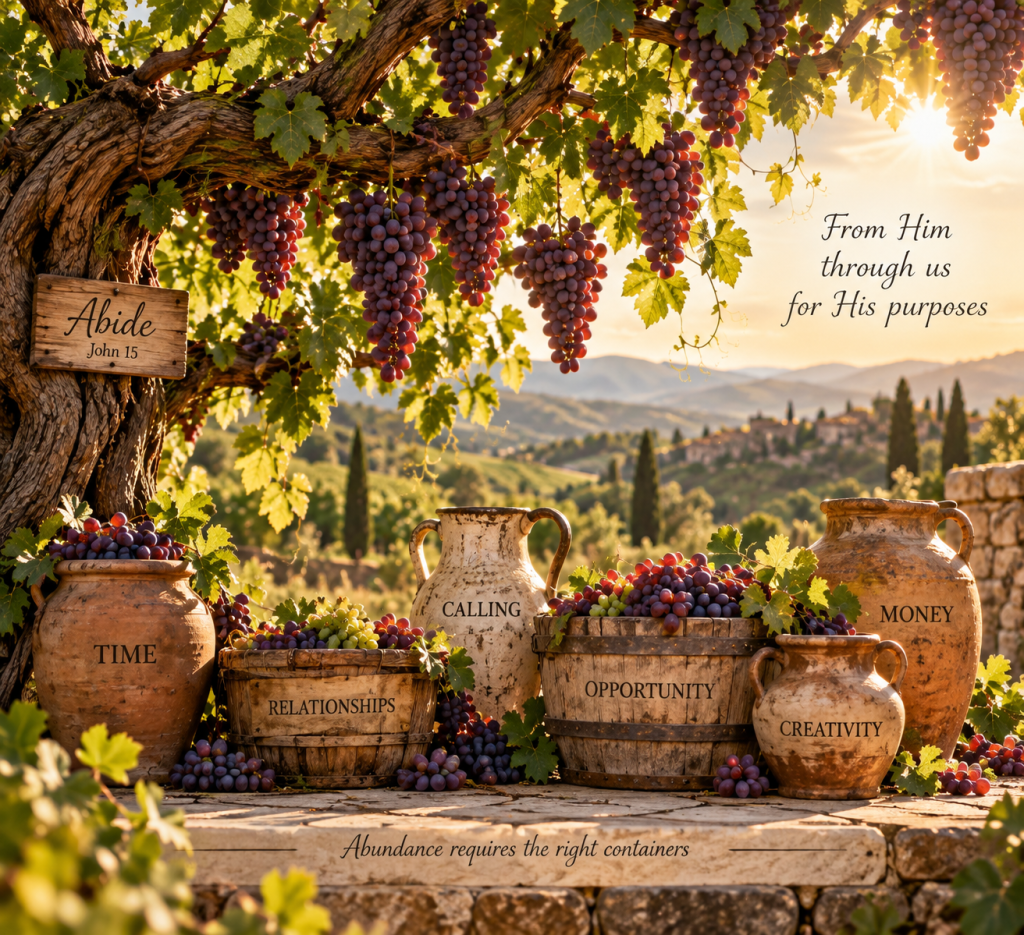
  • Perfectly Unfinished Me DEVOTIONS🌿| We All Want Abundance. But Where Are We Going to Put It?

    Abundance sounds wonderful, doesn’t it?

    More time. More money. More opportunities. More creativity. More freedom. More of God.

    Without much thought, at first I’d say, yes please. I’ll take the lot.

    There’s just one small problem.

    Where exactly am I going to put it?

    I’ve realised recently that I already have an abundance of quite a few things. Ideas, for example. I have an extraordinary number of those. Unfortunately, I don’t necessarily have an abundance of time, money or space in which to do anything with them.

    I also have an abundance of thoughts.

    I just don’t always appear to have access to them. With an abundance of factors blocking their access — brain fog, menopause, busy lifestyle, medical factors — take your pick.

    I can be halfway through saying something genuinely profound, stop for approximately three seconds and discover that the entire thought has apparently locked itself away somewhere in the building.

    Perhaps this is not the kind of abundance I had in mind.

    Then there’s my piano.

    I own a piano. I love playing the piano. At present, however, actually getting to the piano requires a degree of logistical planning because of how we’ve had to arrange the space in our house.

    So there it sits.

    An abundance of piano.

    A slight shortage of access.

    And yet, if I did have access, would my procrastination lose its grip long enough to let me focus, or would my motivation actually kick in enough to play it?

    And sometimes I wonder whether that’s what we do with abundance generally.

    We pray for more. We work towards more. We talk about prosperity and living abundantly. And there is absolutely nothing wrong with wanting more.

    I would quite happily have more money.

    There. I said it.

    I don’t worship money, but I can think of plenty of things I could do with it. Things I could create. People I could help. Ideas I could actually develop rather than adding them to the increasingly overcrowded waiting room inside my head.

    But perhaps the more important question isn’t simply, Do I want more?

    Perhaps it’s:

    What would I do with it if I got it?

    Because abundance needs somewhere to go.

    It needs a container.

    And if the container isn’t big enough, organised enough or ready enough to hold what’s being poured into it, abundance can start to feel remarkably like overwhelm.

    And that’s where Solomon comes in.

    “Ask for whatever you want me to give you.” — 1 Kings 3:5

    Imagine that.

    Anything.

    Solomon could have asked for riches. A long life. Victory over his enemies.

    He didn’t.

    He asked for a discerning heart. Wisdom to govern God’s people and to distinguish between right and wrong.

    And God was pleased with his answer.

    Solomon was offered anything he wanted, and he asked for the wisdom to steward what he had already been given.

    Because he already had something enormous.

    A kingdom.

    What he recognised was that having something and having the capacity to carry it well are not the same thing.

    And because Solomon asked for wisdom rather than riches or honour, God gave him the wisdom he asked for — and also gave him riches and honour that he hadn’t asked for.

    That challenges me.

    Because I’m quite good at asking God for the next thing.

    More time would be lovely.

    More money would be extremely useful.

    More opportunities? Absolutely.

    More ideas?

    Actually, perhaps we could put a temporary hold on those until I’ve dealt with the existing backlog.

    But maybe sometimes the prayer I need isn’t:

    Lord, give me more.

    Maybe it’s:

    Lord, give me the wisdom, the tenacity and clarity to know what to do with what You’ve already given me.

    Because information isn’t enough.

    I can know exactly what I ought to eat and still eat something else.

    I can know I need rest and still fill the time with noise.

    I can know I want to write and spend the time I could have been writing scrolling through my phone.

    I can have an idea that genuinely feels as though God has given it to me and still need discernment to know whether it is for now.

    Not every good thing has to be done today.

    Some things need wisdom.

    Some need clarity.

    Some need capacity.

    Some need tenacity.

    And all of them need stewardship.

    Jesus spoke about this too. He said that whoever can be trusted with very little can also be trusted with much.

    There’s that uncomfortable word again.

    Trusted.

    Because if I’m asking my Heavenly Father for more, perhaps it’s reasonable for me to look at what I’m doing with the little — or actually, the considerable amount — that I already have.

    Take time.

    I frequently feel as though there simply isn’t enough of it.

    I work full-time, which means around forty hours of every week are already allocated before I begin thinking about writing, creating, exercising, building things, spending time with the people I love, playing the aforementioned inaccessible piano, or simply sitting still long enough to remember what I was thinking about five minutes ago.

    And yes, there are times when I would very much like God to release me into something different.

    But then I have to ask myself an irritating question.

    What am I doing with the time I do have?

    Because apparently telling God I could accomplish extraordinary things if only He gave me more time becomes slightly less convincing when my phone can produce documentary evidence to the contrary in the form of my screen-time report.

    There are moments when I wonder whether I’m waiting for the next season while failing to properly inhabit this one.

    Perhaps there are things I’m learning here.

    Gratitude.

    Discipline.

    Patience.

    Consistency.

    How to do something when I don’t particularly feel like doing it.

    How to steward small pockets of time before asking for enormous ones.

    That doesn’t mean we have to pretend to love every season we’re in. Nor do I believe wanting change automatically makes us ungrateful.

    Sometimes we really do need things to change.

    But I don’t want to spend so much time staring at the next mountain that I miss what God is teaching me on this one.

    Because if I don’t learn it here, will I simply carry the same habits into whatever comes next?

    Will I finally get the time I’ve been asking for and discover that I still don’t know how to use it?

    Will I get the opportunity and discover I haven’t developed the capacity to carry it?

    Will I get the abundance and then wonder why it feels so heavy?

    Maybe before we pray for bigger harvests, we sometimes need bigger barns.

    Not necessarily bigger physical ones.

    Bigger capacity.

    Greater wisdom.

    Better discernment.

    The tenacity to actually put into practice what we already know.

    And perhaps contentment belongs somewhere in all of this too.

    “I have learned the secret of being content in any and every situation, whether well fed or hungry, whether living in plenty or in want.” — Philippians 4:12

    I appear to have achieved plenty and want simultaneously.

    I have plenty of ideas and not always enough money to execute them.

    Plenty I want to do and not always enough time.

    Plenty of thoughts and, as previously established, occasionally limited access to them.

    But when I stop looking exclusively at what I don’t have, I realise how much abundance is already sitting around me.

    I have a husband I love, whom there was a time I never knew I would meet.

    I have an extraordinarily loving dog who would presumably like an abundance of treats.

    I have a home.

    I eat every day.

    I have choices about what I eat — something I’ve become much more aware of since changing my diet and discovering both how much money I used to spend on things I didn’t need and how little we actually need to be satisfied.

    I can rest.

    I can create.

    I can worship freely.

    I can complain about working eight hours and getting paid for it while people elsewhere in the world work far harder in circumstances I can barely imagine, sometimes without freedom, security or enough food.

    That doesn’t mean my frustrations aren’t real.

    Gratitude doesn’t require pretending something is perfect.

    But it does require me to stop occasionally and recognise what is already here.

    And yet, strangely, when I think about all the things I want more of, there is one abundance I find myself craving more than the others.

    Jesus.

    His presence.

    Intimacy with Him.

    Time to sit with Him and hear Him properly.

    I miss those moments when He gives me pictures, when something suddenly becomes clear, when I recognise His voice and know He is showing me something.

    And perhaps sometimes when I feel as though God has gone quiet, the problem isn’t that He has gone anywhere.

    He promised never to leave us or forsake us.

    Perhaps sometimes my life has simply become very loud.

    I can ask for intimacy with the Lord but intimacy needs a container too.

    Time.

    Attention.

    Stillness.

    Space.

    A willingness to put something else down.

    “Better is one day in your courts than a thousand elsewhere.” — Psalm 84:10

    The writer goes on to say he would rather be a doorkeeper in the house of God than dwell in the tents of wickedness.

    That puts abundance into perspective.

    Because I could have an abundance of money.

    An abundance of opportunities.

    An abundance of possessions.

    An abundance of ideas.

    I could finally acquire all the time, space and resources I currently think would make everything easier.

    But Jesus asked a rather sobering question:

    “What good is it for someone to gain the whole world, yet forfeit their soul?” — Mark 8:36

    The whole world.

    Now that really is abundance.

    And yet Jesus makes it clear that even that can amount to nothing if, in gaining it, we lose what matters most.

    So perhaps the question isn’t simply, How much can I gain?

    Perhaps it’s also, what is it costing me to gain it?

    If my pursuit of more money costs me my peace, is that prosperity?

    If more opportunities leave me with no time for the people I love, is that abundance?

    If I’m so busy trying to fulfil every idea I’ve been given that I have no time left for the God who gave me the ability to have them, have I really gained anything at all?

    Maybe prosperity has more faces than we realise.

    Maybe abundance does too.

    Perhaps the question isn’t whether it’s wrong to want more.

    I don’t think it is.

    Perhaps the questions are:

    Why do I want it?

    What will I do with it?

    Do I have the capacity to carry it?

    Am I stewarding what I already have?

    And most importantly:

    What am I becoming while I wait for it?

    James tells us that if any of us lacks wisdom, we should ask God, who gives generously.

    Perhaps that is one prayer for abundance we can make without worrying about where we’re going to put it.

    More wisdom.

    Wisdom to know what deserves our time.

    Wisdom to know which ideas are for now and which can wait.

    Wisdom to recognise when we genuinely need more and when we simply haven’t noticed how much we already have.

    Wisdom to create the right containers for whatever God entrusts to us next.

    And wisdom to remember that the greatest abundance I could ever possess isn’t something I can put in my bank account, squeeze into my diary or somehow find room for beside the piano.

    It is knowing Him.

    Everything else is temporary.

    One day, this life — with its crowded diaries, unfinished projects, financial limitations, inaccessible pianos and mysteriously disappearing thoughts — will be the briefest part of our story.

    For those of us who belong to Christ, eternity awaits.

    So yes, I still want abundance.

    I still have dreams.

    I still want more time, more freedom and enough money to do some of the things I believe have been put on my heart.

    But perhaps before I ask God to pour in more, I need to look at the containers.

    And perhaps the wisest prayer isn’t simply:

    Lord, give me more.

    Perhaps it’s:

    Lord, give me the wisdom to steward what You have already given me — and prepare me to carry whatever You choose to give me next.

    Jesus said that whoever can be trusted with very little can also be trusted with much (Luke 16:10), and told us to seek first His Kingdom (Matthew 6:33). Perhaps those two things belong together. We are called to steward faithfully what God has already placed in our hands, while remembering that our first priority is Him. Before all the projects, plans, opportunities and things we hope He might entrust to us next, He wants us close enough to know His heart. Because abundance without wisdom can become overwhelm, and abundance without Him can leave us strangely empty.

    So perhaps before we ask God to fill our lives with more, there’s a better question:

    Lord, am I making room for You in the abundance I already have?

    Lord, I need You. I can’t do any of this without You. Help me make room for You before I ask You to make room for more. Fill me with Your presence, give me Your wisdom, and let everything I do flow from knowing You first.

  • This Week’s Nonsense: Apparently Everyone Wants My Attention


    This week Britain continued its national hobby of commentating about the weather.

    Half the country says it’s far too hot.

    The other half says it’s not as hot as 1976.


    Personally, I was less concerned about settling the climate debate and more concerned about keeping Zeb entertained without melting him.

    Before anyone starts, no, I wasn’t marching a collie around in 29-degree heat.

    He’s got a garden.

    He’s got shade.

    He’s got a pond.

    He’s got far more cooling options than most of us.

    So we played ball in the garden. Not on the grass though. We are growing that back ever since he decided to kill the last lot.

    Unfortunately, the ball landed in a bucket.

    Now, this isn’t some mysterious new bucket.

    This bucket has lived in the garden for ages.

    Sometimes it’s empty.

    Sometimes it catches rainwater from the drainpipe.

    Sometimes I use the water for topping up the pond.

    And despite the fact that I regularly try to stop Zeb drinking from it, he has decided that rainwater with muck from the bucket is apparently superior to fresh water from his bowl.

    So putting his head in the bucket is usually not a problem.

    He’ll practically climb inside it if he thinks there’s something interesting to drink.

    But the moment his ball landed in there?

    Different story.

    Suddenly the bucket became an object of deep suspicion.

    He stood staring at it.

    Whining at it.

    Looking at me.

    Looking back at the bucket.

    Looking at me again.

    Pacing back and forth between me, Gareth and

    the bucket…

    As though we were somehow responsible for the existence of buckets.

    What should have been ten minutes of throwing a ball turned into half an hour of convincing a perfectly intelligent collie that the bucket he regularly sticks his face into was not planning to harm him.

    This is the face of a dog who stared down a bucket and lost.

    This is also the same dog who, earlier in the week, decided he was brave enough to bark and growl at another dog twice his size because apparently he had strong opinions.

    Yet ten minutes later a leaf moved in a bush and he nearly launched himself into another postcode.

    The confidence is selective (as well as the hearing)

    Meanwhile, all I wanted this week was an extra hour of sleep – actually an extra week would be good.

    I’d had about five hours because my body clock apparently enjoys making life difficult.

    All day I was thinking, “When work is finished, I’m having an hour’s sleep.”

    I regularly look at my husband sat asleep in a chair, or anywhere, I’m sure he could sleep standing, thinking

    Ahhh look at him.

    Lucky git.

    Must be so nice to have that ability.

    Jealous? Much?

    The moment the opportunity arrived for me to sleep, everybody wanted something.

    The doorbell wanted something.

    Work wanted something.

    The dog wanted something.

    Amazon wanted me emotionally invested in a parcel that was allegedly one stop away.

    My bladder wanted something.

    Everybody had needs.

    Gareth informed me the parcel was one stop away.

    An hour later it was still one stop away.

    At that point I concluded Amazon was operating on prophetic timing.

    The thing that struck me this week is that I keep saying I want peace and quiet.

    I want time to think.

    I want time to pray.

    I want time to sit with God.

    Yet when I finally get five minutes with nobody wanting anything from me, I immediately find something else to do.

    I’ll check my phone.

    I’ll make a drink.

    I’ll remember a job that suddenly feels urgent.

    I’ll find something to be frustrated about.

    It’s strange really.

    People sometimes say, “You just like being busy.”

    No, I really don’t.

    I don’t wake up in the morning hoping for more stress.

    I don’t dream of having more interruptions.

    I don’t spend my afternoons thinking, “What I really need right now is another problem.”

    Yet somehow I can spend all day wanting peace and quiet and then struggle to settle down when I finally get it.

    As Christians, we know we’re saved by grace.

    We know we don’t earn God’s love.

    We know we don’t earn His attention.

    Jesus has already made a way for us to come to the Father.

    Yet sometimes I still act as though I need to get everything sorted before I can sit down with God.

    I’ll just finish this.

    I’ll just do that.

    I’ll just sort out one more thing.

    Then I’ll spend time with Him.

    The problem is that there is always one more thing.

    One more email.

    One more job.

    One more interruption.

    One more bucket-related crisis involving a collie.

    Scripture tells us that the enemy comes to steal, kill and destroy.

    Sometimes I think one of the easiest things for him to steal is attention.

    Not necessarily through dramatic sins or obvious rebellion.

    Sometimes just through noise.

    Through distraction.

    Through the constant feeling that something else needs doing first.

    We live in a microwave culture where everything is instant, and after a while you get so used to noise and interruptions that stillness starts to feel uncomfortable.

    Which is probably why the verse says:

    “Be still, and know that I am God.”

    Not because being still is easy.

    But because for some of us it’s surprisingly difficult.

    The good news is that God already knows this.

    He isn’t sitting there waiting for me to become perfectly focused before He’ll talk to me.

    He already knows I’m tired.

    He already knows I’m distracted.

    He already knows I’m the sort of person who can turn a ten-minute game of fetch into a half-hour lesson on bucket confidence.

    And He still says, “Come.”

    Apparently everyone wants my attention.

    And when nobody wants my attention, I’m not always sure what to do with it.

  • The Fan Wars, The Missing Water Bottles and Everything In Between

    There are many types of people in this world but when it involves fans, I believe there are two particular types.

    Those who sleep with a fan.

    And those who think the fan is trying to create an Arctic blizzard in the bedroom.

    For eleven months of the year, my husband acts like the fan is his mortal enemy.

    “I can’t stand that thing, it’s freezing!”

    Meanwhile, I’m lying there wondering whether spontaneous human combustion is actually a thing.

    Honestly, the drama is impressive.

    Then…

    The temperature creeps up to 30°C.

    Suddenly, the same man who has spent the rest of the year declaring war on the fan is lying directly in front of it like he’s discovered the greatest invention since sliced bread.

    Honestly, the change from pure hatred to desperation is breathtaking.

    Since hitting my forties, I’ve discovered this isn’t just our house. Nearly every woman I’ve spoken to around my age has had some version of the same conversation.

    She needs the fan.

    He thinks the bedroom has somehow become the North Pole.

    And then there’s the menopause brain fog.

    Because apparently, once your hormones start changing, your brain occasionally decides it would like a little holiday too.

    One evening, after a long day and very little sleep, I decided to be a lovely wife and make Gareth a hot drink when he got home.

    In fact, it’s a regular evening occurrence when he arrives home from work. I like to do nice things for him.

    He doesn’t get home until around 11 o’clock at night, so by that point my brain was already running on whatever tiny bit of battery was left.

    I picked up his flask from beside the bed like I always do because I normally empty it before making him a fresh drink.

    He was invested in something to do with his other work.

    Only this time…

    My brain decided to take the evening off, as it seems to do these days, without my permission.

    I started pouring the contents down the sink.

    Then halfway through, my brain finally whispered:

    “That looks an awful lot like hot chocolate.”

    Followed by:

    “I wonder if I should actually be pouring this away…”

    Whilst simultaneously watching my hand continue pouring it down the sink in slow motion, like it wasn’t actually part of my decision-making process.

    By the time it finally landed in my brain, it was too late.

    Gone.

    Down the drain.

    Along with any chance of winning Wife of the Year.

    I made him another drink and took it in.

    He looked at me.

    “Where’s my hot chocolate?”

    I froze.

    “…It was an accident.”

    “You threw it away, didn’t you? Why would you do that?” he said, looking wounded and somewhat confused.

    “You watched me pick the flask up!”

    “Yeah…”

    “But I wasn’t actually paying attention.”

    Touché.

    Fair point.

    Apparently, neither of us was fully functioning at that point.

    And that’s marriage in a nutshell really.

    Two tired people, both doing their best, occasionally getting it completely wrong.

    And speaking of things disappearing…

    There are the monthly water bottle investigations.

    Usually about once a month, I hear it.

    The huffing.

    The cupboards opening.

    The slightly dramatic searching noises coming from the kitchen.

    And I already know what’s coming.

    “Where’s my water bottle?”

    Now, we actually bought five water bottles all in one go.

    Five!

    So explain to me how a household with five water bottles can still reach a point where we can’t find a single one.

    And naturally, the first person under investigation is me.

    “Have you moved it?”

    “Have you taken it to work?”

    “Have you put it somewhere?”

    And, to be fair…

    Many times the answer is yes. 😂

    Sometimes I have moved it to under the sink.

    Sometimes I’ve taken one with me.

    Sometimes I’ve sat with one on the bed and forgotten about it.

    And sometimes I have put something somewhere that made perfect sense at the time…

    but appears to have become invisible afterwards.

    But occasionally…

    Just occasionally…

    I know absolutely nothing about the missing bottle.

    And at that point, I feel I deserve an apology from the actual culprit.

    Whoever that may be. 😂

    Although, strangely, the investigation usually ends before we discover any evidence.

    I do feel sorry for my husband because he had no idea that who he was marrying would someday not be able to locate parts of her own brain.

    And maybe that’s the strange thing about marriage.

    We marry people at one stage of their life, but then we get the privilege of walking alongside them through all the stages that come afterwards.

    The changes.

    The challenges.

    The things neither of us expected.

    And speaking of things we didn’t expect…

    I would also like to have a word with the people responsible for introducing the ageing process into the world.

    Adam and Eve, I’m looking at you.

    One act of disobedience brought death and decay into the world in many forms.

    And while I’m not saying they are personally responsible for my menopause brain fog, missing water bottles or the occasional lost thought…

    I would like to politely ask them what exactly they were thinking.

    Thanks for that. 😂

    Then there’s my favourite fan story.

    I come home from a 3K run looking like I’ve just crossed the Sahara.

    Sweaty.

    Red-faced.

    Completely overheated.

    “It’s roasting!”

    Gareth agrees.

    “It really is.”

    “So… why haven’t you turned the fan on?”

    “Because you were out running.”

    I stare at him.

    “The fan is literally six feet away.”

    “I know…”

    “But you weren’t here.”

    Honestly, I still haven’t worked out the logic behind that one.

    And maybe, underneath all the fan wars, missing water bottles and accidental hot chocolate disasters, there is something a little deeper.

    Because … and I know I’m saying this again but…

    I sometimes wonder what it must be like for a man watching the woman he married go through menopause.

    To watch someone who has always been capable, organised and on top of things suddenly stand there and say:

    “I genuinely have no idea what I was doing.”

    That must be strange.

    But from the woman’s side, it can feel strange too.

    Because there are moments where you don’t even recognise yourself.

    You wonder where the person went who could remember most things, juggle everything and keep all the plates spinning.

    Now you’re standing in the kitchen wondering why you walked in there in the first place.

    Meanwhile…

    You still have to pick up the evidence.

    Like the boots.

    Because why do men have a perfectly good shoe rack, thoughtfully provided in the hallway, but somehow their boots still end up in the middle of the bedroom floor?

    And the answer is probably simple.

    They’re tired too.

    They’re human too.

    Just like we are.

    Marriage is basically two people doing their best while occasionally driving each other slightly mad.

    One person loses their memory.

    The other loses their motivation to use the shoe rack.

    Both are equally confusing.

    But then there are the beautiful bits.

    Someone waiting for you to come home.

    Someone making you a drink at 11 o’clock at night.

    That first cuddle after a long day.

    Laughing at the ridiculous things only the two of you understand.

    And, of course, having a dog who looks at the garden destruction he’s caused and somehow still believes he’s innocent.

    (We’re looking at you, Zeb.)

    Because life isn’t made up of perfect moments.

    It’s made up of these ordinary ones.

    The messy ones.

    The funny ones.

    The ones where you annoy each other and then five minutes later you’re laughing together.

    Maybe that’s one of the greatest gifts of marriage.

    Having someone who sees all of you…

    The organised you.

    The tired you.

    The menopausal brain fog you.

    The “where did I put that?” you.

    And loves you through all of it.

    Not a perfect relationship where nobody gets irritated, forgetful or overheated…

    But one where grace quietly turns up in the ordinary moments.

    The fan wars.

    The missing water bottles.

    The brain fog.

    The accidental disasters.

    They’re rarely the moments we treasure while they’re happening.

    But one day, they’ll probably be the stories that make us laugh the hardest.

    Although…

    I’m still sleeping with the fan on.

  • When Everything Goes Wrong At Once…And You’ve Just Had Enough

    I haven’t posted for three weeks. And if you’ve been wondering where I went — here’s the honest answer. Life just did that thing it does.

    Some seasons just come at you. Not one thing. Not even two things. Just wave after wave after wave, until you’re standing at your front door trying to get your husband to work and the door won’t lock because of the heat, and you think — of course. Of course that’s happening as well.

    You know you’ve hit a certain level of done when you walk to the shop and realise halfway there that you’re still in your slippers, look at the reflection in the window and see your hair looks like an alpaca’s because you haven’t brushed it. And instead of turning back, you just think — you know what, I genuinely do not care. The slippers are staying on and the hair can just stay alpaca style. I am getting my thing and I am going home. There’s something almost liberating about it, in a completely rock-bottom sort of way.

    That’s what a long run of hard things does to you. It turns you into a version of yourself that just… keeps going. Not gracefully. Not with your hair done. Just going. One foot in front of the other, slippers and all.

    I’m not someone who wants the biggest house. I genuinely don’t have enormous expectations. I just want to pay my way, live comfortably, and do what I’m called to do. That’s it. But right now, even that feels like it’s asking too much.

    People let you down financially. Prices rise. Petrol goes up. Doors you thought were opening shut quietly in your face. Lodgers move out. The laptop breaks. The car breaks and then the front door! One thing rebounds off the next until you genuinely don’t know what’s left in you. Some days the wall just stares back.

    And if that’s where you are right now — I want you to know you are not on your own.

    That Voice

    And then there’s that negative voice.

    From a Christian perspective, there’s an enemy out to kill, steal and destroy. We call him Satan. Sometimes it’s him, sometimes it’s just our own inner critic with the volume turned up. But it comes in quiet, and it starts with two words. If not coming from that perspective, call that voice what you want but it’s still there. Gnawing at you with that question.

    What if.

    What if it doesn’t work out. What if the door never opens. What if this is just how it is now. What if, what if, what if — and each one leads to another until you’re so far down that road you can’t even see where you started.

    The only time “what if” is ever useful is when it goes the other way. But what if it does work? What if the door opens tomorrow? What if what I can’t see yet is already in motion?

    I don’t want to be better than anyone else. I’m not built for competition. I just want to be the best version of me — the one I believe God called me to be — and I want to crush my comfort zones getting there. That’s enough. That’s all I’m after.

    But when everything is pressing in, the doubt gets louder. And into that quiet the voice says things like — you’ve failed. You’re irresponsible. You can’t do this. Who do you think you are? The promise was a lie.

    And here’s what I’ve learned to say back:

    How is investing in your future a failure? The only failure is never trying the thing you believe you were made to do. If I try and it doesn’t work — so be it. At least I tried. And if I somehow end up in a cardboard box — well. At least it’ll make a good blog post.

    But seriously — you cannot take my mind. And if you can’t take my mind, you can’t take me.

    But there’s also another level to go and we’ll go there with the word of truth from my favourite book.

    Hope Deferred

    There’s a verse that does something most Christian advice doesn’t — it tells the truth about waiting.

    “Hope deferred makes the heart sick, but a longing fulfilled is a tree of life.” Proverbs 13:12.

    Not hope deferred makes you stronger. Not hope deferred is character building. Hope deferred makes the heart sick. And if you’ve been waiting for something — a door to open, a situation to turn, a promise to land — and it keeps not happening, you’ll know exactly what that sickness feels like.

    It’s the wind going out of your sails. Your whole persona deflating. That gut-drop moment when another thing goes wrong and something in you just goes quiet and dark.

    I know that feeling. I’ve been sitting in it.

    And when you’re there — go and find someone else to encourage. I know that sounds counterintuitive. But when you encourage others, something shifts. You stop staring inward at the darkness and start looking outward. It forces you out of yourself. And sometimes that’s all it takes to get through the day.

    Because you’re not the only one going through something. Not by a long way. Let me encourage you. There’s a second part of that verse which says: a longing fulfilled is a tree of life. So there is hope. We must always believe for that no matter what. It can come just at the 11th hour in a way we weren’t expecting. I’m speaking to myself here too.

    The Word That Speaks Life

    Have you noticed how much easier it is to default to the negative?

    We are so good at it. The world is good at it. Bad news travels faster than good news, criticism lands harder than encouragement for most of us — and when things get genuinely rough — most of us have the potential to go down that road. The spiral is always there, waiting.

    Which is exactly why the Word of God matters so much. Not as a rule book. Not as a list of things you should be doing better. But as something living — something that speaks life back into you when everything else is speaking death.

    That’s why it needs to be drilled into our souls. Read it, know it, sit with it — so that when the moment comes and you have nothing left, the Holy Spirit can bring it back to you at exactly the right time. A word you read six months ago suddenly meaning everything right now. That’s not coincidence. That’s how it works.

    I won’t pretend I always do this perfectly. I don’t. Some days I manage it well. Some days I fail spectacularly. But I keep coming back. Keep trying. Keep running my own lane, not anyone else’s.

    Dangerous Songs

    There’s a song — Oceans by Hillsong United — “Spirit lead me where my trust is without borders, and I’ll walk upon the waters, wherever you may call me.” And we sing it. We really sing it. Hands in the air, completely meaning it.

    And then life delivers the answer to that prayer.

    And you think — oh. Oh no. I didn’t mean it quite like THIS.

    I don’t think the people who wrote it knew exactly what they were asking for either, if I’m honest. I think they sang something like it, got absolutely taken apart by life, came out the other side with their faith changed forever — and THEN wrote the song. Out of the fire. Not before it.

    Because you don’t become a diamond by being comfortable. The diamond is made under pressure, under heat, with everything that isn’t the real thing burned away. All the dross, all the chaff, everything that was never going to last anyway.

    Nobody enjoys that process. Nobody. But you can’t skip it and still get the diamond.

    And the people who’ve been through it? You can tell. There’s something in them that wasn’t there before.

    Saint Paul

    I have a friend I call Saint Paul. That’s not his real name — he’s called Paul — but if you knew him, you’d understand why I call him that. He’s kind of like a spiritual Dad in a way.

    He prays for what feels like a hundred people a day. Always remembering. He is the most genuinely grateful person I have ever known. Not because his life has been easy — it hasn’t, not by a long way. He’s had his trials. Real ones. But through all of it, there is this quality about him. A graciousness. A steadiness. A way of being grateful even when there’s every reason not to be.

    He sets a standard, without even trying to. Just by being who he is. And I’ve learned more from watching him than from many sermons.

    One of the things he’s taught me — and I’m still learning this — is that you can’t always trust your feelings. You might feel hopeless today and completely different tomorrow. Your emotions are real, but they’re not always telling you the truth. You have to just keep going.

    I look at him and I think — he knows who his anchor is. That’s what it is. That’s the difference.

    And then I look at my dog, Zeb. Who has absolutely no idea what’s going on, but looks at me with such complete and uncomplicated love that I think — okay. Tomorrow might be completely different. Let’s just get through today.

    Then there’s my husband who has this way of bringing himself round from discouragement also. I’m grateful for him. See there is always something to be grateful for though sometimes it’s very hard to dig down.

    Sometimes that’s enough.

    Find Your Anchor

    Maybe this is all a bit too biblical for where you are right now. Maybe Jesus isn’t part of your story yet — or hasn’t been. That’s okay. I’m not here to tell you what to believe.

    But I will say this — find your anchor. Whatever holds you when everything else is pulling. If it’s your dog, your friend, a word of encouragement you stumbled across, a piece of music that reaches somewhere words can’t — hold onto it. Use it to get through today.

    And if you’re ever ready to find the true anchor — the one that holds in every storm, not just this one — He’s not going anywhere.

    The Promise Is Still There

    And when the faith feels thin — and it will feel thin sometimes, I won’t lie to you — remember that Jesus said faith the size of a mustard seed is enough. You don’t need a mountain of it. Just enough to take the next step.

    And if even that feels like too much, there’s a prayer in scripture that I think is one of the most honest things ever said to God:

    “Lord, I believe. Help my unbelief.”

    Not I have it all together. Not I’m completely trusting you. Just — I believe. Help me where I don’t.

    He can work with that.

    The apostle Paul — the biblical one, not my friend 😄 — writes in Romans 8:18:

    “Our present sufferings are not worth comparing with the glory that will be revealed.”

    And this, from Jeremiah 29:11:

    “I know the plans I have for you. Plans to prosper you and not to harm you. Plans to give you a hope and a future.”

    In my darkest hours I’ve often been sarcastic with that verse and said “Yes, I know YOU know the plans you have for me but would you like to tell ME what they are?”

    But if He did, that wouldn’t require faith would it? Because it says in Hebrews:

    “Now faith is the assurance of what we hope for and the conviction of things not seen.” (Faith even as small as a mustard seed, remember.)

    But think about it — the promise IS that He has plans.

    Not maybe. Not if you get it right. Plans. Already made. Already in motion.

    Hold on to that. Even on the wall-staring days. Even on the days you’ve got nothing left and the door won’t open and everything is conspiring against you.

    Tomorrow is another day. And today has enough of its own troubles without borrowing it.

    Until the race is won.

  • That’s Not My Name…

    Most of us like to think there’s something unique about us. And there is. Even those of us who say we don’t care about standing out — we still have that one thing. That thing that’s ours.

    For me, my name is the first thing I don’t like people getting wrong. It sets the precedent.

    Now before we go any further — it’s Samantha. Not Sam. And I can already hear some of you going — “Hang on, your name on here is Sammi Joe but you’re telling us your name is Samantha? Make your mind up!” Fair. I’ll come back to that. 😄

    And yes, I know what you’re thinking. What’s the big deal? Sam, Samantha — same thing, right?

    Wrong. And it gets worse. Because it’s somehow even more galling when it happens in a full name context — first name AND surname together. That’s supposed to be your proper, formal name. The grown up version. So to still reach for Sam at that point? Sam Jones instead of Samantha Jones? You had the right format and still got it wrong. That takes a special kind of commitment to laziness. Jones is my married name by the way — but the point stands whatever name I’m carrying.

    And don’t even get me started on a register or a formal document. Your full proper name is right there in black and white and someone STILL shortens it? That one really gets me.

    I should probably warn you at this point — I have two things that bypass all my usual politeness very quickly. Eating sounds. And being called Sam. I’m a fairly calm person generally, but catch me on either of those and all bets are off. If anyone puts Sam Jones on my grave, my spirit will not be at peace. Biblically incorrect as that may be.

    But first, let me tell you about the time I went to the doctor.

    He came out into the waiting room, looked at his list — my full name right there in front of him — and called out “Sam Rumble?” Rumble being my maiden name at the time.

    I looked up at him and said, completely deadpan — “Oh, is that what it says on the name register?”

    He went rather sheepish.

    “Samantha Rumble?” he said. In a question tone. Like he wasn’t quite sure he was allowed.

    “That’s better.”

    You should have seen his face. I’m still not sure if it was fear or inner annoyance at the patient who had the audacity. But I’m a doctor’s daughter. I had the confidence. I used it. No regrets. 😄

    It’s Only Two More Syllables

    I mean, come on. AN-THA. That’s all I’m asking. Two extra syllables. We’re not learning Mandarin here. If you genuinely, truly cannot stretch to the full Samantha — then Sammi Joe works. Sammi with an I by the way, not a Y. I have my reasons. We all want to be a little unique, don’t we?

    But not Sam. Never just Sam.

    And honestly? I could call myself Sammi General and people would STILL find a way to call me Sam. I rest my case.

    Sam Was Someone Else

    Here’s the real reason.

    Sam was the name I went by when I was a different person. Insecure. Making choices I’m not proud of. Living in a way that wasn’t aligned with who I was created to be. Sam wasn’t a bad person — but Sam was lost, and Sam was hurting, and Sam was doing what lost, hurting people do.

    And then God showed up.

    Slowly, steadily, everything changed. The insecurity, the bad decisions, the old patterns — God began to strip them away and replace them with something better. Something more solid. More me.

    And the name I came back to was Samantha.

    Samantha means God heard. And He did. He heard me in the mess, in the noise, in the bad decisions and the quiet desperation. He heard me, He answered, He called me into something new.

    So when someone calls me Sam, it doesn’t just feel like a preference being ignored. It feels like being called back to someone I no longer am. Like being handed an old coat you donated years ago and being told to put it back on. Sam is part of my story — she always will be, and I don’t erase her — but she is not who I am today.

    Samantha is feminine for me. Samantha is chosen. Samantha is heard by God.

    That’s not a small difference.

    And yes, I go by Sammi Joe here. I chose that deliberately. It sits comfortably between the two. Not Sam — never Sam — but not quite ready to put Samantha above the door either. Think of it as the in-between. The journey name. And yes, I see the irony. Also, it seems if it was Samantha, people would definitely more likely change it Sam. Sammi-Joe has less risk. Don’t tell me. You’re tempted to write back and call me Sam now aren’t you, just to spite me?

    And since we’re being pedantic — my full name is actually Samantha Joanne Jones. I wasn’t expecting the doctor to reel all three off, that would just be odd. There are social norms after all. But Samantha. Just Samantha. That’s not too much to ask.

    And if you’re wondering where Sammi Joe actually comes from — well. Samantha Joanne Jones. There it is. It was never random. It was always me, just in a different order.

    Why Do I Keep Mentioning God?

    You might be wondering why God keeps showing up in a post about what people call me. Fair question.

    But for me the two are inseparable. He created me. He chose me. He changed me — with purpose. My name isn’t just a preference, it’s part of that story. And if you’ve landed here and had a look at my About Me page, you’ll already know that faith is woven into everything I write. So He was always going to show up.

    And actually, names and identity are all over scripture. Which brings me to some people who might have felt exactly like I did in that waiting room.

    You’re Not The First Person This Happened To

    God has always taken names seriously. Some of the most significant moments in a person’s journey with God are marked by a name change.

    Take Abram. Faithful, but waiting. Holding onto a promise he couldn’t yet see. And then God meets him and changes his name to Abraham — father of many nations — before he had even seen the fulfilment of what was promised. The name came before the reality. God called him into his future before it arrived.

    Then there’s Jacob. Now Jacob is a fascinating one. His very name meant deceiver — and he lived up to it. He was a schemer, a manipulator, a man who got what he wanted through cunning rather than integrity. But then he had that extraordinary night of wrestling with God, and when morning came, he walked away with a limp and a new name. Israel. One who wrestles with God. Same man, completely different identity.

    Can you imagine, after that, someone strolling up and calling him Jacob? Like nothing had happened? Like he was still the deceiver? I imagine it would have stung in a way that’s hard to articulate. Not just rude — but a denial of everything God had done in him.

    (And if your name is Jacob — I’m sorry. I’m sure you’re lovely. Not all Jacobs are deceivers. Probably.) 😄

    And then there’s Simon. Impulsive, emotional, the one who put his foot in his mouth almost as often as he said something profound. Jesus looked at him and called him Peter — the rock— even before Simon had become anything like a rock. It was a prophetic name. A calling. Jesus wasn’t describing who Simon was — He was declaring who Simon would become. And not just any rock — the foundation on which the entire church would be built. Imagine being given that name. Imagine carrying that calling. Every time someone called him Peter, they were speaking his destiny over him whether they knew it or not.

    Names, in God’s economy, are not throwaway labels. They carry identity. They carry destiny. They carry testimony.

    It Works Both Ways

    I want to tell you about my husband Gareth.

    Gareth means God’s gentle man. And I’m not being biased when I say he absolutely lives up to it — plenty of other people have said the same. He’s six foot tall, and yet there is this quality about him. A gentleness. A kindness. An approachability that just oozes out of him. You feel at ease around him immediately.

    Now, he might argue that his behaviour didn’t always match that. That before God changed him, he wasn’t always living up to the name he was carrying. But here’s what I’d say — you could always see it in him. It was always there. In his eyes, in his presence, in the way people were drawn to him even then. The gentleness was written into him. God just brought the behaviour into line with what was already there.

    And that’s the thing — God works both ways.

    For me, Samantha was always my name. It was always there. But I spent years behaving like Sam — the lost, insecure version — until God called me back to who I was always meant to be. I had to grow back into my name.

    For Gareth, the name always fitted. But he had to grow into it. To become in behaviour what he already was in identity.

    Same God. Same intentionality. Different directions. He just has this way of making the person match the name, or the name match the person, whichever way around it needs to go.

    And then there’s Zebedee. My dog. Named after the father of James and John in scripture — a perfectly respectable biblical name. Except he has absolutely no interest in living up to it. He is, without question, the Zebedee from the Magic Roundabout. All bounce, no dignity whatsoever. He also seems to prefer Zeb. I can’t even win with the dog. 😂🙈

    And Then There Are The Karens

    Can we just take a moment for the Karens?

    I genuinely feel sorry for every woman named Karen who went to bed one night with a perfectly lovely name and woke up to find it had become internet slang for someone demanding, entitled, and permanently ready to speak to the manager.

    Here’s the thing though. Karen, in its biblical roots, carries a meaning that couldn’t be further from that cultural caricature. It speaks of strength, power, and purification. Now I’ll grant you — if you squint hard enough, power might go some way to explaining the manager situation. 😄 But strength and purification? That’s not someone demanding a refund. That’s someone with real weight and dignity behind their name.

    So if your name is Karen — or if you carry any name that the world has decided to redefine, mock, or dismiss — can I just say this: the world does not get the final word on what your name means. Culture is loud, the internet is louder, but neither of them are the authority on your identity.

    Which, actually, is the whole point of this post.

    Names Mean Something

    Whether it’s God renaming someone in scripture, a woman choosing what she wants to be called, or the internet hijacking a perfectly good name — there is always meaning attached. Always identity attached.

    And if you still think names are just labels, consider this — why do people spend years, sometimes a lifetime, tracing their family tree? Why does someone who was adopted feel that deep pull to find out their original surname, their heritage, where they came from? It’s not just curiosity. It’s because something in us knows that a name carries more than letters. It carries belonging. History. Identity. God wired that into us whether we realise it or not.

    You see it all through scripture too. Matthew opens his gospel with a genealogy — a long list of names tracing the family line of Jesus all the way back through the tribes of Israel to Abraham. Luke takes it even further, all the way back to Adam. And I’ll be honest with you — the first time I read it, I thought, seriously, God? Every single name? It felt like the most skippable passage in the Bible.

    But then something stopped me. It was almost as if I felt Him say — would you like me to forget your name? Would you like your story left out? Because that’s what those lists are. They’re not filler. They’re not boring admin. Every name in that genealogy is a real person, a real story, part of the unfolding of His Story. Every single one mattered enough to be recorded. And if He kept track of every name in a bloodline stretching back thousands of years, do you really think yours doesn’t matter to Him?

    And then there’s the woman in the gospels with the issue of blood. She’s never named. Not once. The crowd didn’t notice her, and scripture doesn’t record her name. But Jesus stopped. In the middle of a crowd, He stopped for her. He saw her. He knew her. Her name might not be written in the text — but it was known by Him. And that’s the point. You don’t have to be famous, or recorded, or remembered by the world. If He knows your name, that’s enough.

    Your name can hold your history. It can hold your testimony. It can hold the distance you have travelled from who you once were. And if someone has told you their full, chosen, preferred name, the most respectful thing you can do is use it. Not because they’re being oversensitive. But because identity matters. And the journey a person has taken to arrive at who they are today deserves to be honoured — not casually abbreviated.

    A Question For You

    Do you know what your name means? Where it comes from? Not every name has a direct biblical reference — and that’s fine — but most names have a root, an origin, a story behind them somewhere. It might surprise you. And even if the meaning feels like it has nothing to do with who you are, maybe that’s its own interesting question worth sitting with.

    And whether the meaning resonates or not, here is the bigger question:

    Has God ever spoken a new identity over you? A new way of seeing yourself that replaced the old story you used to carry? A sense that who you were is not the final version of who you are?

    Because that is what He does. He did it for Abram. He did it for Jacob. He did it for Simon and He did it for me.

    If He’s done it for you too — I’d love to hear about it in the comments.

    Your name is not just a label. It’s a story. Make sure you’re living from the right chapter.

  • It’s Just a Dorito. And Yet.

    There is a sound that can ruin my entire day. Yours probably wouldn’t even register it.

    I have misophonia.

    Which sounds dramatic until you realise it just means that certain sounds — specifically other people eating, clanging, repetitive tapping, or basically existing loudly near me — make me want to quietly leave my own life for a moment.

    It’s not a mood. It’s not me being difficult. It is, apparently, an actual neurological thing, which is both validating and completely useless when someone sits next to you with a bag of crisps.

    Now, I should clarify — I am not naturally a patient person. Patience is one of those fruits of the Holy Spirit that God is very much still working on in me. It is a process. A long one. And situations like these are not helping.

    ⸻

    Everything can be completely calm.

    Peaceful, even.

    The kind of quiet where nothing feels rushed and everything just… settles.

    You’re watching something nice.

    Or sitting somewhere quiet.

    Or just existing without any particular issue.

    And then someone starts eating.

    ⸻

    It’s not gradual.

    There’s no gentle build-up.

    It’s like something in your brain just switches.

    Suddenly, you can’t concentrate on anything else.

    Not the film.

    Not the conversation.

    Not even your own thoughts.

    Not Just… crunching, lips smacking or like your food is doing the world tour in your mouth before swallowing. My Dad does that and at these times, our relationship level is at best, questionable! In fact every relationship is.

    ⸻

    And it’s not just “a bit annoying.”

    That would be manageable.

    This is the kind of irritation that feels completely disproportionate and yet — at the exact same time — entirely justified.

    You become hyper-aware.

    Why is it so loud?

    Why is it that loud?

    Has it always sounded like that?

    Surely it hasn’t always sounded like that.

    ⸻

    And the worst part?

    You know it’s irrational.

    You are fully aware that this is a completely normal human activity.

    People eat.

    They’re allowed to eat.

    They’re not doing anything wrong.

    And yet internally, you have transformed into something that could only be described as a mildly restrained rage monster.

    ⸻

    I don’t say anything. Usually.

    Out loud, I remain civil — right up until the point where my nervous system decides that civility is no longer a viable option.

    At which point, all bets are off.

    (See: the Doritos incident.)

    But internally, even on the quieter days, there is a whole negotiation happening between

    “be a reasonable person”

    and

    “please, for the love of all that is good, stop chewing like that.”

    ⸻

    The worst example of this happened in a library.

    A library. The internationally recognised sanctuary of silence. The operating theatre of academic thought.

    I was studying for my dissertation. This required, at minimum, the kind of quiet usually reserved for lunar surfaces and very serious doctors.

    And then the man next to me opened a bag of Doritos.

    Doritos.

    I turned and looked at him. If you have misophonia, you will know exactly what that look is. It is not aggressive. It is not rude. It is simply a look that communicates, without any words at all, the complete and total collapse of your inner world.

    He saw the look. He acknowledged the look.

    And then he continued eating.

    So I leaned over and said — very calmly —

    “Doritos?!”

    And then: “What is this, a picnic?!”

    He stopped eating.

    ⸻

    What makes it even more ridiculous is this:

    If I am eating at the same time… it’s absolutely fine.

    No issue at all.

    Apparently, the solution to the problem is simply that I must also be involved in the eating.

    Which, as Blod once pointed out, feels somewhat unfair.

    “So it’s fine if you eat, but not if I do?”

    Correct.

    That is, unfortunately, exactly how it works.

    I didn’t design it. I just live with it.

    You know who can eat without triggering my internal meltdown though?

    My dog Zeb

    Zeb, who eats like he’s in a competition and the prize is making as much noise as humanly-

    or should I say, caninely-possible.

    Completely fine. Not a flicker of rage. Not a single twitch.

    I have no explanation for this. My nervous system apparently has a “dog clause” built in somewhere that nobody told me about.

    Blod finds this fascinating. I on the other hand would find it deeply personally offensive.

    ⸻

    Blod made a quiet and life-altering decision early on in our relationship — that eating crisps during a film was perhaps not worth the consequences.

    This was during the dating phase.

    The fact that he still married me after witnessing the look in its natural habitat is something I find both touching and mildly surprising.

    Occasionally, he forgets.

    Hunger, I suppose, does something to a person’s memory.

    And then he remembers again — usually around the time I’ve gone very quiet, or started pressing Blu-tack into my ears with the focused calm of someone who is absolutely not calm.

    That is love, actually. Documented and real.

    ⸻

    It’s not limited to eating, either.

    Clanging. Repetitive tapping. Someone doing the same small sound over and over in a place that’s supposed to be quiet.

    It all qualifies.

    Which is why I cannot attend church connect groups when food is involved.

    I have tried.

    I become a version of myself that I don’t particularly enjoy. Internally unravelling while outwardly attempting to look like someone who is fine and engaged and not at all being destroyed by the sound of someone’s wrap.

    It is exhausting.

    ⸻

    And then there are the people who don’t quite understand it.

    “It’s only crisps.”

    Yes.

    I know.

    Logically, I am aware that it is only crisps.

    Unfortunately, my nervous system appears to have interpreted it as something far more serious.

    ⸻

    The strangest part is how instant it is.

    One moment: a calm, relaxed, reasonable human being.

    Next moment: internally calculating how quickly you can leave the situation without drawing attention to yourself.

    ⸻

    It’s not a personality flaw.

    It’s not even really a preference.

    It’s more like a very specific, slightly inconvenient wiring issue that occasionally turns something completely normal into something… not quite so manageable.

    ⸻

    So if you ever notice someone go very quiet the moment you open a snack…

    Or reach for earplugs — or Blu-tack, we’re not fussy — with the quiet focus of someone defusing a bomb…

    Or suddenly remember they urgently need to be in a different room…

    Be kind to them or run. Either works.

    Maybe even offer them some of your food.

    We realise this is not exactly preferable.

    Especially if it’s soup.

    But we didn’t choose this. We are doing our best to avoid incarceration.

  • Scissors, Tea and Mild Emotional Trauma: Let Me Introduce You to the Hair Salon

    Because apparently, changing your hair fixes everything!

    There’s a strange, unspoken belief—particularly among women—that when life isn’t quite going to plan, the obvious solution is to fix the hair. Not the actual problems, of course. Those can simmer away nicely in the background. But the hair? That needs immediate attention. Because nothing says “I’ve got my life together” quite like sitting in a chair while someone with scissors makes life-altering decisions on your behalf.

    You walk into the salon thinking, This is it. “New hair, new me.” You’re half expecting to leave with improved confidence, emotional stability, and possibly a promotion. At the very least, you’d like to leave looking vaguely like the picture you showed them on your phone.

    And it always begins the same way.

    “Would you like a tea or coffee?”

    The Unreachable Drink

    Now, obviously, you do say yes, because most of us love part of the pampering session to include a lovely beverage. Five minutes later, it arrives and is placed just out of reach while your arms are firmly imprisoned beneath that cape.

    And there you sit for the next three hours, watching it slowly go cold, attempting the occasional subtle elbow stretch in the hope that someone might notice your silent plea. They never do. By the time you finally manage a sip, it’s reached the temperature of mild disappointment.

    I’ve learned from this. I now bring my own cold iced latte in a can. Not because I’m difficult—simply because hydration shouldn’t require a rescue mission. Not being able to access a drink that’s sitting in front of you teasing you isn’t something that I blame the hairstylist for; I mean, they are being nice and oh so hospitable, but I find it a repeatable point of amusement. Do hairdressers not know this? I’m very surprised no one has come up with a practical solution for Dragon’s Den. Investors. An extendable attachment from the table with a sippy straw.

    The Alpaca Incident – 1998

    My first real lesson in hairdresser diplomacy came back in 1998. I went in for what was described as a “do something slightly different but make it good.” Had I known I would come out looking like an alpaca, I would have stayed home with my own hot drink!

    The stylist decided to scrunch-dry my hair. Now, anyone with naturally curly hair knows this requires soaking wet strands and a generous amount of mousse. Instead, it was attempted on partially dry hair, resulting in an explosion of frizz so impressive it could probably be seen from space. Not only that, but the guy had cut it to a length I did not volunteer for. My mum had just paid £70 for the privilege—an extortionate amount at the time—and I was then presented with the mirror.

    “So, what do you think?” he smiles, totally unaware of the crime he had just committed.

    What did I think? I thought I might need to relocate and start a new identity. But in true British fashion, I smiled weakly with my insides crying and said, “Yeah, it’s great, thank you.”

    I left the salon, asked my mum to pass me a scrunchie immediately, and tied it up. I think she was just as in denial as the hairdresser, as she acted annoyed at me hiding the sculpture she had paid for. I didn’t release it back into the wild for several weeks.

    For years afterwards, I perfected the art of nodding enthusiastically at hairstyles that bore absolutely no resemblance to what I’d asked for, mainly because I didn’t want to upset someone who was still holding scissors near my ears. Self-preservation, really.

    The Safe Years

    Thankfully, there was a peaceful period when my stepsister, who is a brilliant hairdresser, took charge of my hair. She actually listened, which, as it turns out, is quite a rare and delightful quality. My hair remained safe, healthy, and recognisable. It was a golden era in what can only be described as my follicular journey.

    The £200 Disaster

    Then, about twenty years after that original frizz catastrophe, I decided—foolishly—to try somewhere new. This particular stylist charged around £200 for a cut and colour. Despite my very clear instructions not to layer my hair in certain areas, she did exactly that. What is wrong with these people!

    I left the salon feeling as though the only appropriate accessory would be a paper bag. You know it’s bad when you start planning your route home based on the likelihood of encountering people you know, only to get home and my husband says nothing. Poor bloke was waiting for me to compliment him on cleaning the entire house and ordering a takeaway, and he gets a homecoming from a wife who now needs her hair tidied up.

    The £300 Blonde Ambition

    Not long after, I visited another salon with the idea of dealing with the orange tone in my hair from a keratin treatment (don’t ask) and getting it blonde again. The stylist confidently quoted a price of £300. Three hundred pounds. For that amount of money, I expected not just good hair but emotional healing and perhaps a small holiday.

    Of course, I refused to pay that price, and I was ready to walk out the door—and SHOULD HAVE! So the price had been negotiated to a more reasonable offer.

    But the real drama came when he decided the best course of action was to bleach most of my hair in as many foils as possible.

    Not a few highlights. Not a gentle transition. He wanted to use all of the foil in Mr Tin Man’s shed!

    “No,” I said, with the calm certainty of someone who has seen this film before and knows exactly how it ends.

    He looked at me, slightly offended. “Why don’t you let me do my job?”

    I decided on the most obvious reason. “Because it’s MY hair, I guess, and I also want to keep it on my head.” So I came out with frazzled ends at the frame of my face, which I had already warned him were fragile and not to touch with bleach.

    Thankfully, I had rescued another brutal haircut when I viewed, like in cinematic slow motion, the pull of the crown section of hair—hands gliding upwards, with the scissors aimed at lobbing a good 2–3 inches off. “Noooooooo, don’t cut that off, stop.” He stopped, hence just layering the front round the face. Seriously, I should be an advocate for the victims of hairdressing disasters.

    Finding the Right Hairdresser

    Eventually, I found a lovely hairdresser who genuinely knew what she was doing. She explained that in order to achieve the rich brown shade I wanted, we’d first need to go through a slight tint red stage. I left the salon feeling slightly startled but reassured, trusting the process and, more importantly, trusting her.

    During this appointment, I was offered not one, not two, but three cups of tea—all of which sat just out of reach while I remained trapped beneath the cape. At this point, bringing my own drink felt less like a preference and more like a survival strategy.

    The Mirror Ritual

    And then, of course, comes the final ritual: the mirror.

    “What do you think?”

    You’re handed a small mirror and expected to assess the back of your own head—which can often not be seen because the angle always seems off-placed.

    “Could you just move it a bit? I can’t quite see the back.” The mirror is manoeuvred side to side until you confidently approve. “Ahh yes, that’s a lovely back of head, thank you.” Often it takes several twists and turns of the mirror. Wait, why am I looking at the back of my head again?

    I definitely, in many respects, have gained confidence in speaking out in the hairdressers. It’s either being post-40s or just the long list of disasters that I just cannot go through it again, because then I pay twice.

    On one occasion, I even asked to borrow the straighteners to tame a stubborn section of frizz myself. Not because the stylist wasn’t capable, but because I finally trust my own understanding of my hair. It’s amazing how empowering it feels to take control of your own fringe.

    A Note on Hairdressers

    I should add that I’m fully aware that many hairdressers work incredibly hard and aren’t exactly rolling in it. For the good ones—because they are out there—behind the prices we see are professionals trying to earn a living, often within salon structures where they don’t receive the full amount clients pay. When someone genuinely looks after me, I’m more than happy to support them.

    But even with that understanding, there’s still that moment of shock when you hear the price. Then again, it’s not just hair—petrol, groceries, everything has gone up. I won’t go there yet. We all understand why!

    More Than Just Hair

    There’s something deeply symbolic about changing your hair. Often, it reflects a desire to regain control when other aspects of life feel uncertain, or perhaps even an attempt to change something within ourselves. You go in hoping for transformation and come out feeling, at the very least, a little fresher and more like yourself again—provided it actually looks good.

    Because that’s the truth of it. A trip to the hairdresser won’t change your life. It won’t solve your problems or magically turn you into a new person. But if it turns out well, it can make everything feel just a little bit more manageable.

    And if it doesn’t… well, there’s always the scrunchie. After all, it’s my hair.

  • The Dog Who Thinks He’s Walking Me

    You know when your dog tries to drag you down the road, attempts to dismantle your sanity, and makes you question every life decision that led you to owning him…

    …and then five minutes later looks at you like this?

    Like he’s never done a single wrong thing in his entire life.

    This wasn’t even a peaceful field walk either.

    This was a round-the-block situation.

    You’d think that would be easier.

    No.

    Apparently not.

    When I got him, I thought it would be nice, peaceful walks around the country park.

    No.

    That is not how this turned out.

    It actually ends up with me dreading the walks, feeling like I need to hit the wellness section in the supermarket for a bottle of Kalms.

    There I am, holding him in, my arm taking the strain, while he’s scanning the environment like it’s his full-time job to locate chaos.

    And if I didn’t keep hold of him?

    He’d absolutely try and launch into full zoomies mode at the worst possible moment… straight towards whatever’s moving.

    Cars included.

    Lovely.

    Now I can already hear people thinking,

    “Why are you even walking him round the pavement then?”

    Good question.

    Catch-22.

    Because if I do—

    he’s got cars going past, and he’s movement triggered so anything that moves is apparently his responsibility. Brilliant.

    But if I don’t—

    he never learns how to deal with it, and the one time he does end up near a car without me properly managing it? Disaster waiting to happen.

    And then there are the claws.

    If I don’t walk him on harder ground, they grow like he’s preparing for some kind of medieval battle, and he ends up walking funny.

    But can I just take him to a normal groomer?

    No.

    Because he thinks every human being exists purely to be launched at with the highest enthusiasm 

    Which, apparently, groomers don’t appreciate.

    So… here we are.

    Damned if I do, damned if I don’t.

    And let’s not even start on the “say hello to everyone” phase.

    Other people out on their walks, minding their own business—or worse, the ones who actually want to say hello to a Border Collie/Welsh Sheepdog.

    He would, if given the chance, lick them all over and probably go home with them.

    But you see… we’ve been here before.

    One time he was so scatty he literally wrapped a woman’s legs in the long lead.

    A stranger.

    I don’t think she’ll be wanting to say hello again.

    One inch of slack on that lead, and suddenly he’s like,

    “Perfect. Freedom. Time to behave like an absolute lunatic.”

    Then we get home.

    I think, “Right, safe space, back garden—we’ll calm down.”

    Do we calm down?

    No.

    Because the second that lead loosens slightly, he decides he’s basically off-lead and goes full rampage mode, like he’s auditioning for a wildlife documentary.

    Zoomies. Chaos. Limbs everywhere.

    At one point he got a bit carried away with himself…

    So I rein it back in, get him settled, give him his little… whatever that thing is.

    Hoof. Foot. Claw. Who knows.

    Slight tuggy.

    And then—

    Just like that—

    He settles.

    Lies down.

    Soft eyes.

    Angel.

    Aren’t you, baby?

    Yes, you are.

    Well…some of the time.

    Because let’s be honest—

    sometimes he looks at me with that little sideways glance like,

    “Yeah… I’ve got you wrapped round my paw.”

    You little menace.

    And the worst part?

    It works.

    Because one look at that face…

    …and I still absolutely love him.